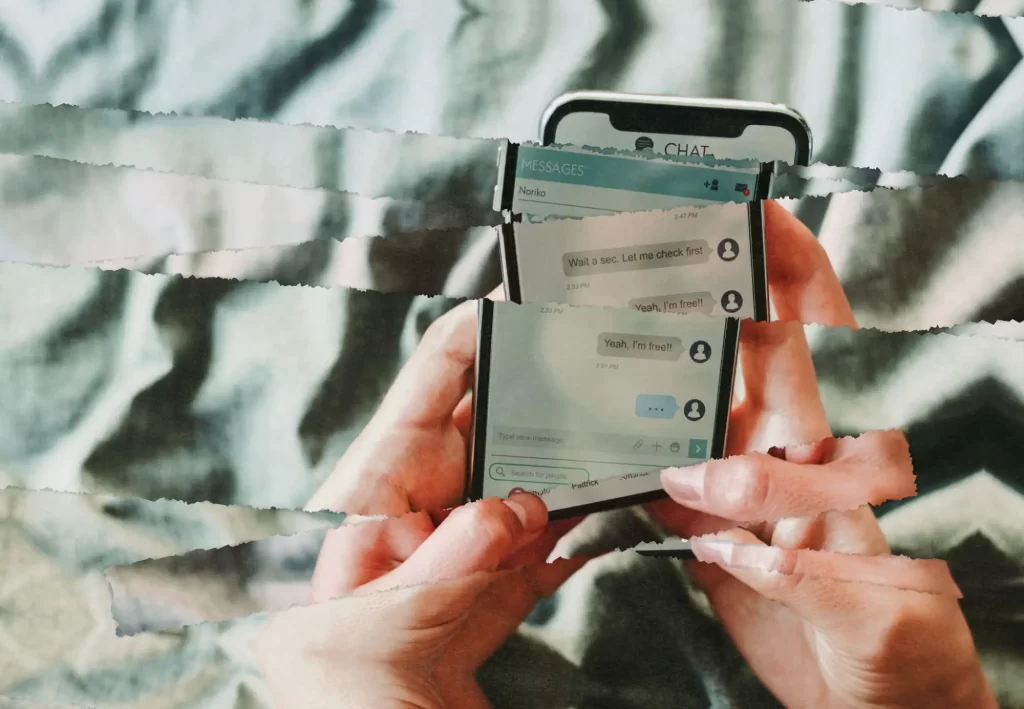
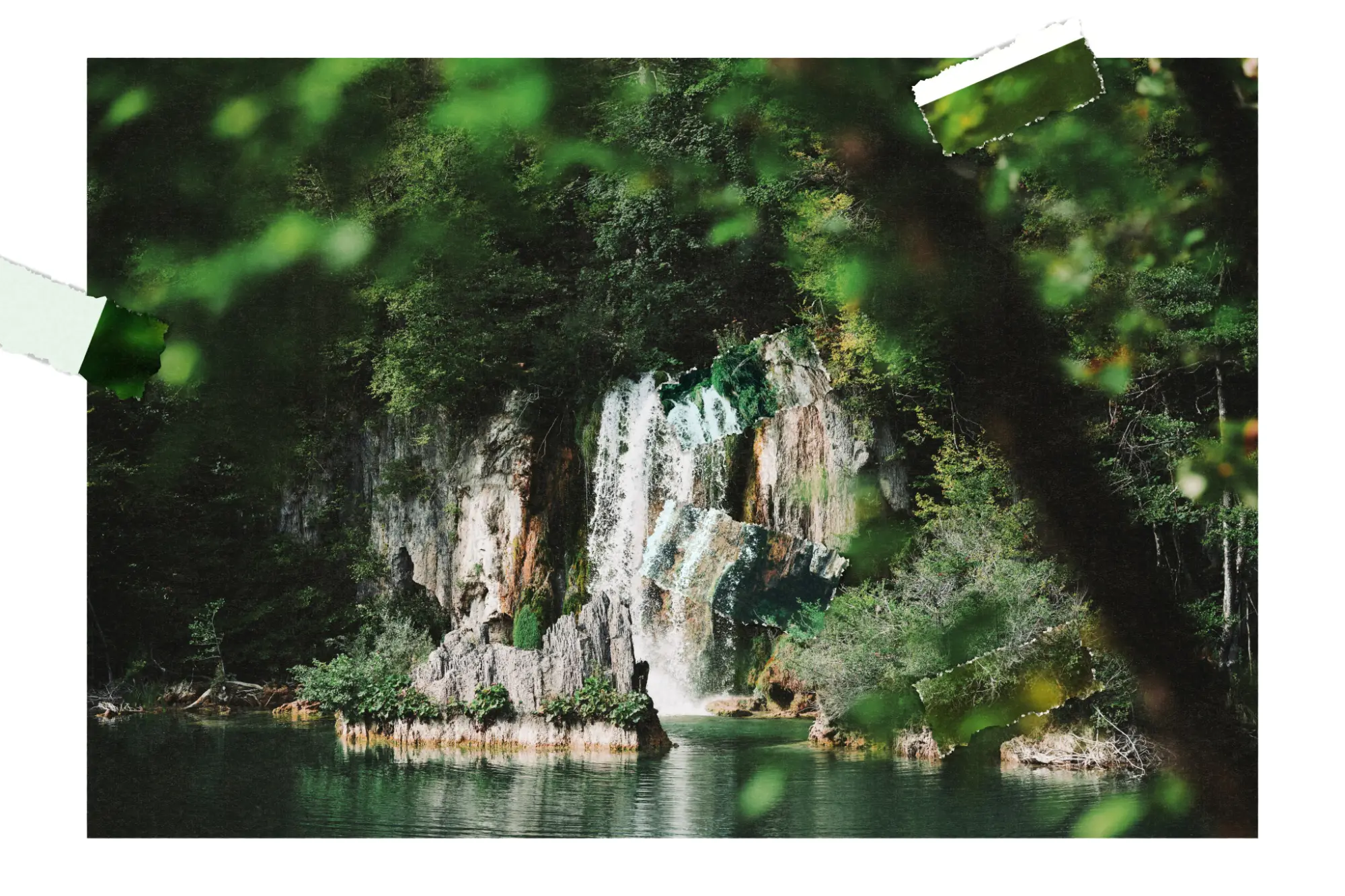
You are still in bed and the family group chat lights up. Someone has forwarded a photograph: Plitvice at night, waterfalls glowing turquoise, and above them a sky lit with northern lights, ribbons of green and pink folding over the forest, stars bright in surprisingly photogenic compositions. Underneath, three heart emojis and a line of text: Noćas na Plitvicama!
It is a breathtaking picture, surely a once-in-a-lifetime moment, yet it is hard to say at once what it is. The northern lights really have been seen from Croatia. But this sky is a little too vivid, the waterfalls a little too bright for a dark night, every detail a little too perfect. It might be a real photo, a heavily edited one, or an image generated in seconds from a single sentence and questionable motives.
But notice what happens next, in the few seconds after you see it. Do you scroll on? Do you send a heart back? Do you type that’s fake and press send? Or do you pause?
Most of what we see online is neither simply true nor simply false. And perhaps the more important question is not whether the photo is real, but what we do with it once it reaches us. That is where a new kind of literacy begins, and where we can all learn to read a little differently: not only forward, line by line, but sideways.
A new kind of literacy
We usually think of literacy as something we finish learning in our first years of school: letters, then words, then sentences. But every era asks us to learn to read again. Once it was the newspaper, then the evening news, then the search bar. Today we read images that may have been generated in seconds, videos that may have been stitched together to construct falseness, and posts that arrive without an author, date or place.
This new literacy is less like grammar and more like a sense. Think of the way someone who grew up by the sea can feel the jugo coming before the forecast says so, or how a cook knows from the smell alone when the bread is ready. Nobody memorised a rulebook for that. It grew through attention, repetition and many small mistakes. Reading the digital world works the same way: an intuitive hesitation when a photo looks too perfect, when a headline feels too urgent. This new literacy is another sense we can train, even if there are less exercise books than when we were learning to write.
One of the most useful exercises for that muscle has a simple name: lateral reading. Developed by the Stanford History Education Group, it means opening several tabs and searching across them to check a claim, instead of reading one page from top to bottom (1). It is not so new, really. It is what we once did at a library desk, with three books open side by side, comparing what each one said. What is on the desk has simply changed.
Reading sideways can move in more than one direction. It can move across sources: from the post to a second tab, then a third, to a library catalogue, a friend or an expert, until we can see where a claim sits among all the others. It can move in time: stepping out of the feed’s forward rush for a moment, letting a story settle and checking whether a photo is from today or from years ago before it becomes today’s news.
Finally, it can move across generations. Many of our grandparents learned to weigh a rumour by asking who said it and how they could know, while many younger readers move easily between tabs, searches and image tools. Naturally, neither way of knowing is complete on its own, each lives in its own sphere. Read side by side, they sharpen each other: the patient habit of asking and the quick hand that can find out in seconds.
Many of us already do this. Across the EU, almost half of people say they cross-check information with other sources when they are unsure about something on social media, and around 40% check whether the source of a post is reliable (5).
Pause. Before you read on, open the source behind that last number in a new tab. Does it say what we say it says? Feel the resistance and the security of reading sideways.
We were taught to read forward,
left to right, line by line,
trusting the page to hold still.
Now the page moves
in ways we’ve never seen.
So we learn to look beside it,
around it, behind it.
Light is never one colour
until we decide where to stand.
The gradient of reliability
It is tempting to sort everything we encounter into two boxes: true and false. But information rarely arrives in black and white, even in print. It sits on a gradient of reliability, and reading sideways means looking at the hues around a claim before trusting its colour, because only then we can truly understand it.
Take the northern lights over Plitvice. On the night of 10 to 11 May 2024, a strong solar storm really did bring the aurora to Croatian skies, unusually far south. Photos from that night sit all along the gradient. Some are honest records of a faint glow above a field. Many are real but brighter than what anyone saw with their own eyes, because phone cameras can gather colours too faint for us to notice – and even more importantly, can change them with a simple slider. Some are real photos from Norway or Iceland, stock images, recaptioned as Croatia. Some were never photographed at all, but generated by an AI tool in a few seconds. Each of these is a different shade and asks a slightly different question of us as its viewers. Try to find the source, the original image.
AI-generated images make this gradient wider than ever. The old tells, like strange hands, warped text and too many fingers, are disappearing as the tools improve. So the most reliable question is no longer does this look real? but where did this come from? Who posted it first? Is there a photographer’s name, a place, a date? Does any other source, a local news site or a conservation group, show the same moment? A reverse image search, which lets you look up where else a picture appears online, often answers this in seconds.
It also helps to know that not every falsehood is a lie. In the EU’s own vocabulary, misinformation is false information shared without the intention to harm, while disinformation is shared deliberately, to deceive (5). Most of what passes through our family chats is the first kind: forwarded with love, by someone who simply found it beautiful, worrying or worth knowing.
Pause. Think of the last image that surprised you online. Where on the gradient would you place it now?
Confidence as another sense
Every sense needs calibrating. Our eyes adjust when we step from bright sunlight into a dark room, and confidence works the same way. It is not simply something we have or lack. It is a skill – one of knowing how sure to be, and when.
Here, Croatia has something to be proud of. In a 2024 Eurobarometer survey of young Europeans aged 16 to 30, three in four believed they had come across disinformation in the past week, and seven in ten felt confident they could recognise it. Young people in Croatia and Malta were the most confident of all (4).
It is another gradient to decide whether that confidence is a positive or a negative. A well-tuned sense of truth is one that knows its own limits, and the complexities of everything around it – not one that is always certain of itself. Across the EU, almost a third of people say they do not feel confident they can recognise disinformation when they meet it (5). And in a global study across seven countries, 39% of people admitted they had shared something false or misleading without meaning to (1).
There is something hopeful in that admission. Admitting that we are wrong is part of the same sense. It is how the muscle learns. A confident reader is not someone who is never fooled, but someone who can say let me check without embarrassment, and I was wrong without shame.
Pause. How sure are you, right now, that everything in this article is accurate? A little doubt is not a weakness here. It is the sense working. What do you do with this?
Confidence is not a wall
we build around what we know.
It is a window,
clear enough to see through,
open enough
to let something new
come in, teach us
to see both
the true and the false.
It’s how we respond
We will all meet false information. That part is not in our hands, even though that is where it finds itself. What is in our hands is the moment that follows: the half-second between seeing and sharing. Perhaps it even matters less whether what reaches us is false, and more how we respond to it.
Most of us don’t share false things out of malice. In the same global study, 55% of people who had shared something false said they did so because they believed it was true, and about a third said they shared on impulse (2). Many described feeling pressure to respond quickly, in the moment. The feed is designed to move forward. Reading sideways asks us to step out of its current for a moment, to come back to what we know is real.
That breath is the pause. It does not need to be long. Long enough to ask: Who made this? Where else can I find it? Why do I want to share it, and what will that do once I do? Who can it ultimately reach, that I wouldn’t expect? How would they read it, understand it, and share it onwards? The answers to these questions might become clearer with use, or increasingly complicated, once we truly think about how unpredictably information travels and generates itself. Research from Stanford found that just six hour-long lessons measurably improved students’ ability to judge whether information was credible (2).
Then comes the harder part: what to say to the person who sent it. Most of us hesitate to correct others online, especially people we love. Yet about a third of people in the global study said they correct someone they know when that person shares something false, always or most of the time (1). Media literacy educators suggest these conversations go best when they begin from our own experience rather than from a verdict: not that’s fake, but I almost shared this too, then I found where it came from. A kind reply can travel as far as the original post. Research summarised by the EU shows that comments pointing out that a post is untrue do influence how others judge it, which is also why it is worth checking our own facts before we leave one (5).
Between the seeing
and the sending
there is a small room.
Step into it.
Sit a while.
It is where we decide
what kind of light
we pass on,
reflect back
or filter through.
Closer to home: a gradient that moves both ways
Croatia seems to stand on the brighter side of this gradient. According to the European Commission, 59% of Croatians have at least basic digital skills, above the EU average of 55.6% (6). We are especially strong at making things: 81.5% of Croatians have at least basic digital content creation skills, compared with 68.3% across the EU (8).
But a gradient moves in both directions. In the Commission’s 2023 report, Croatia stood at around 63%, third in the EU (7); the latest figures show a decline of 3.6% from one year to the next (6). The EU’s goal is for 80% of people to have basic digital skills by 2030. We are on our way, but not there yet, and progress is not something we keep simply by having reached it once.
This is where inclusion comes in. Behind the national average, the picture shifts sharply with age and education: only 17.9% of older adults in Croatia have basic digital skills, compared with more than 86% of young people (9). That gap is not a judgement, but a map of who has had the chance to learn, and who has not yet. Digital literacy only becomes a shared sense when everyone is invited to develop it: the grandmother on the island with a new smartphone, the farmer filling in forms online for the first time, the child getting a first account.
And luckily, the invitations are multiplying. Since 2018, the Agency for Electronic Media and UNICEF have held Media Literacy Days every spring, with workshops, screenings and talks in schools, libraries and cinemas across the country. The 2025 edition focused on disinformation and fact-checking, and the portal medijskapismenost.hr offers free materials for teachers, parents and anyone curious. This school year, the I. Gymnasium in Zagreb became the first secondary school in Croatia to offer Digital Literacy as a structured elective, 35 hours a year of workshops on manipulative content, empathy online and building a safer digital space (9).
A gradient is not a ladder
we climb and leave behind.
It is a field of colour
we hold together –
and it only stays bright
if no one is left
in the shade.
Our next hue: how to read sideways
If every one of us is part of how information travels, then every one of us can change it a little. Checking doesn’t have to feel like suspicion. Once it stops feeling like work, but a part of our digital rituals – it can feel like a needed curiosity that appears once again, a moment of learning something unexpected.
Within reach
- Before you share, pause and ask three questions: Who made this? Where else can I find it? Why do I want to pass it on?
- Open a second tab. Search for the claim, the place or the person, and see what other sources say. That is lateral reading, and it often takes less than a minute to start.
- When an image surprises you, look for its origin rather than its flaws. A reverse image search shows where else a picture has appeared, and when.
- Let yourself be unsure. I don’t know yet is an honest place to stand.
With the people around us
- When someone you love shares something doubtful, reply privately and kindly. Start from your own experience: I almost believed this too, then I found this. Share a source, not a judgement.
- Offer an hour. Sit with a parent, a child, a neighbour or a grandparent and show them a search trick, or ask them to show you how they decide what to trust, or to reach out if they are unsure. Literacy grows in both directions.
- Join or bring your school, library or community centre into Media Literacy Days each spring, or direct the ones who might need it to explore the free materials at medijskapismenost.hr.
Connecting, with Gradient Shift.
Closing
Now, back to the family group chat. The sky over Plitvice is still glowing in green and pink. But this time, someone has replied. Not with that’s fake, or with three more hearts. Instead: Beautiful sight, but I looked it up, and I think this one was made with AI. But the northern lights really were seen over Croatia in May 2024. Isn’t that fascinating? Here are some real photos from that night. Quieter, but real. A few minutes later comes a new reply: I didn’t know. Thank you. Send me more of these.
Nothing dramatic happened. No one was proven wrong in public. A picture moved a little along the gradient, from bright and false towards quieter and true, because someone paused, read sideways, and answered with care.
Somewhere, in a library during Media Literacy Days, a few people of different ages are sitting at one long table, three books open and three tabs glowing side by side, learning the same new language together. The library desk never disappeared. It simply grew wider, wide enough for all of us.
We will keep meeting things that are not quite true. Perhaps the question was never how to avoid them, but who we want to be when they reach us, with which eyes to see.
We cannot stop the light
from bending as it travels.
But we can turn the page sideways,
hold it to the window,
and look
again,
with eyes
that are
always new.
Sources
- Poynter (2022): Survey says large majority think they see misinformation online every week
- TCEA (2022): summary of the Poynter / YouGov global study and Stanford Civic Online Reasoning research
- Poynter MediaWise: Is This Legit? Digital Media Literacy 101
- European Parliament (2025): Eurobarometer Youth Survey
- data.europa.eu (2026): Spotting disinformation – how confident are Europeans in a digital age?
- Digital Skills and Jobs Platform (2026): Croatia – a snapshot of digital skills
- Lider (2023): Croatia ranks third in the EU for digital skills
- U.S. International Trade Administration: Croatia – digital economy
- Better Internet for Kids (2026): Country profile – Croatia