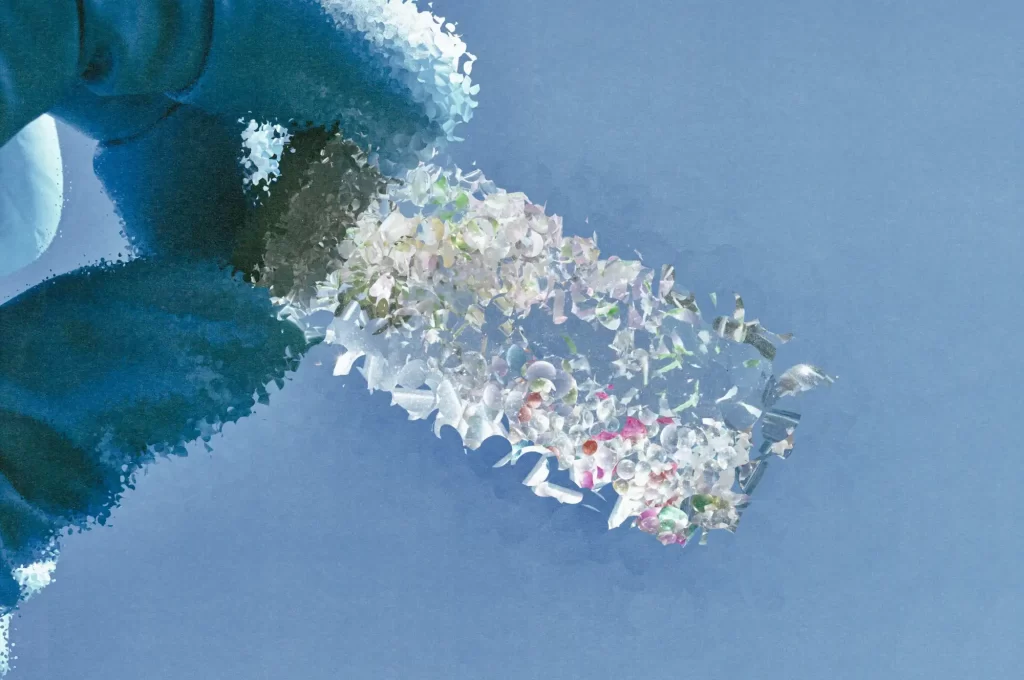
Early morning off the coast of Istria. The water is still, and the light goes down into it in long green columns. At the edge of where you can see, something moves. A small grey body, rounded and smooth, drifting just below the surface. Behind it trails a long, thin tail, curling and uncurling with the current.
For a moment it is a fish. Then it turns, and catches the light, and it is something else. A computer mouse, its cable still attached, swimming nowhere.
It is a strange kind of mistake, and a revealing one. We are used to looking at the sea and finding life in it. Increasingly, the sea is learning to look at our things and find life in them too. A floating object does not stay a stranger for long. Within days, the water begins to claim it.
This is a story about that mouse: where it came from, where it is going, and how far its smallest pieces can travel. It is also a story of where it might never have gone otherwise.
“Disclaimer before use”
Plastic in the sea is too vast a subject to hold all at once. It arrives from car tyres and city dust, from fishing nets and food packaging, from the fibres that loosen from our clothes in every wash. Try to picture all of it together and the picture blurs into something too big to act on.
So in this story we are choosing to follow one thread: the plastic in our electronic devices, from the desk to the drawer to the sea. It is not the largest stream; tyres, textiles and packaging each carry more. We choose it because it is the one most directly in our hands, one that many people don’t know what to do with, and because it is a stream where Croatia already does something well.
Following one stream at a time is a way of learning how to follow any of them, rather than ignoring their vastness. The same questions that guide us here, where did this come from, where is it going, and where could it have turned, can be asked of any discarded object. One day we hope to trace them all, to hold some of them in our hands and projects. It’s impossible to hold the sea in a pair of hands, so for now, we start with one – the mouse held in our hands right this moment.
Downstream: from desk to sea
The mouse began its life on a desk. It clicked through emails and essays for a few years, until a newer one arrived, wireless, sleeker, quieter, offering new mediation with the digital. Then the first moved to the drawer – the first stop on the downward stream.
Most of us have a similar drawer, containing a tangle of old chargers, a phone that might be useful someday, earphones with one side gone silent. Nothing in the drawer is quite waste yet, and nothing is quite in use. It is a pause that can last for years.
Electrical and electronic waste is the fastest-growing kind of waste (1), and around a fifth of it, by weight, is plastic – the casings of our laptops, the bodies of our kettles, the shells of our mice. In 2020, around 66,500 tonnes of electrical and electronic equipment were placed on the Croatian market, and around 40,800 tonnes of e-waste were collected (1). The rest of that year’s devices were still in use, waiting in drawers, or had gone somewhere else.
From the drawer, the stream forks. On one side runs the path we hope for: a collection point, a recycling plant, metals recovered and plastics sorted. On the other runs the path we rarely see: the mixed household bin, the landfill, the wind, the river, the soil and, eventually, the sea.
Recycling, then, is not the end of the story. How we recycle is part of it.
Smaller still: mistaken for the living
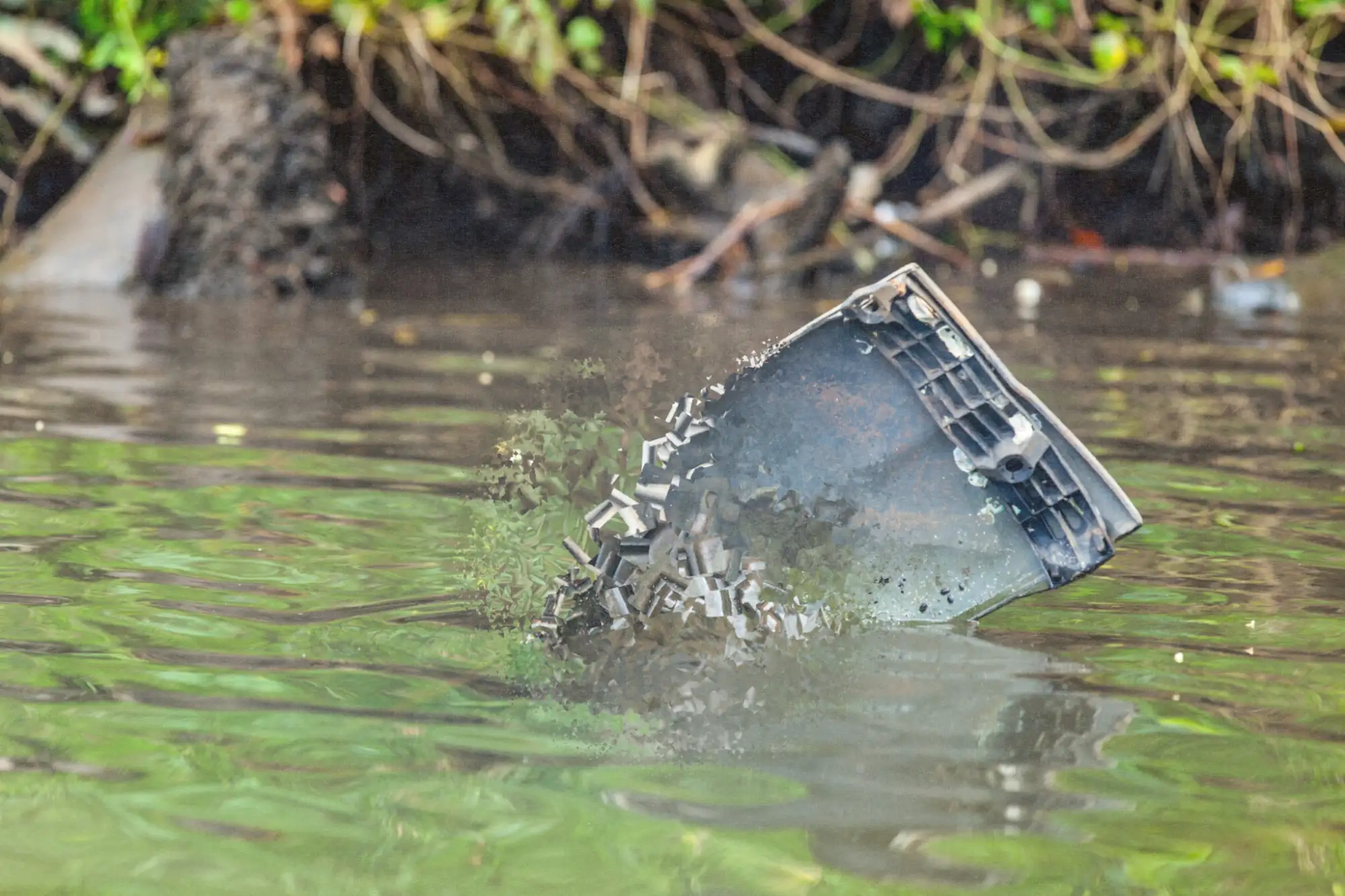
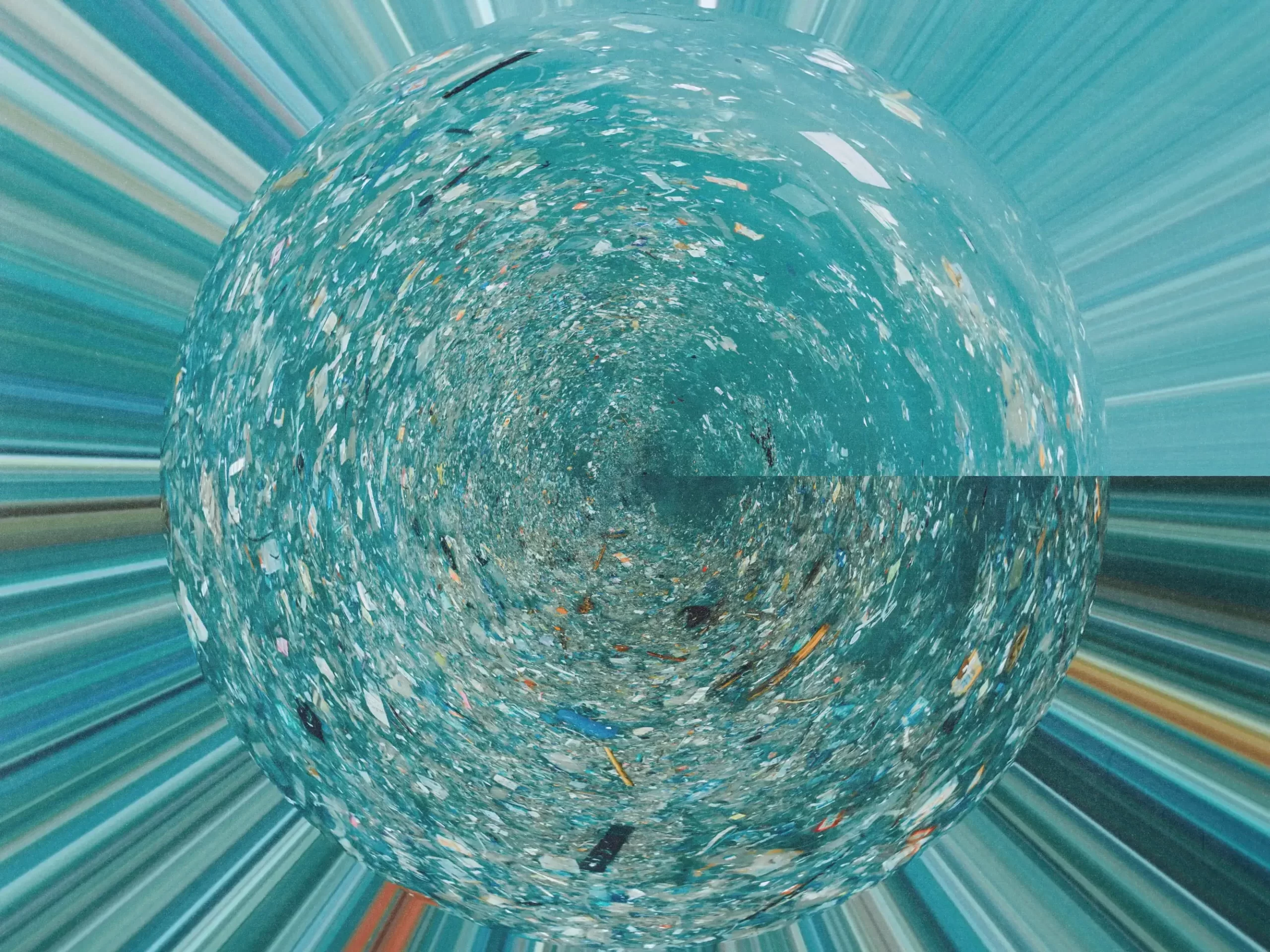
Once in the sea, the mouse does not disappear. It does something slower and stranger: it moves down a gradient of size. Sunlight makes it brittle. Waves and salt and sand wear at its edges. Over months and years, one object becomes ten fragments, then a hundred, then thousands too small to see. A centimetre becomes a millimetre, a millimetre becomes a few micrometres. Pieces smaller than five millimetres are called microplastics, and at the far end of the gradient lie particles so small we are still learning how to measure them, as they get smaller and smaller, eroded through time.
Even a small sea such as The Adriatic holds a great number. Researchers at the Ruđer Bošković Institute’s Centre for Marine Research in Rovinj have measured an average of around 250,000 microplastic particles per square kilometre of the Adriatic, rising at times to around 600,000 in parts of the Rovinj area. One of the centre’s scientists has said that every sample of Adriatic seawater he has processed so far contained microplastic (2).
Is it a comfort
that nothing vanishes?
Everything only grows smaller,
until smaller than a grain of sand,
a speck of light on the water.
What we cannot see
has not left.
It has only come closer,
it has only become
more alive, more alive
than its surrounding.
The turning point: to consume, to respond
Here, at the bottom of the gradient, it is worth pausing on two words we use so often that they have worn smooth – or perhaps, camouflaged in the sea until they become invisible and mundane. Responsible consumption.
To consume comes from the Latin consumere: to use up, to eat, to devour. It is a word that already contains the whole loop of this story. We consume a device. When we are done with it, the sea consumes what is left. The fish consume the sea. And we, eventually, consume the fish, and everything they have consumed until that moment. Consumption is never a straight line ending at the bin. It is a circle, and we are standing on it, consuming it and consumed by it.
To be responsible comes from respondere: to answer. Responsible consumption is therefore not a list of rules and a feeling of guilt. It is consumption that can answer for itself. Where did this come from? Where will it go when I no longer need it? Could it go somewhere better? In our other story on digital literacy, we wrote that what matters is not only the false information we meet, but how we respond to it. The same is true here. The mouse has already been made. What remains open is how we answer it. Everything is an option, it could finally end up any place in the world.
And this is where the question of scale returns. It is often said that individual choices are too small to matter, and that real responsibility lies with companies and governments. Both halves of that sentence hold some truth, and neither is the whole of it. Microplastics themselves show us why. A single particle is invisible and almost weightless. In their hundreds of thousands, they change the colour of a sea, they become geology. Small acts work the same way. Alone, a repaired phone changes very little. Gathered together, small acts become habits, habits become expectations. Expectations become the rules that companies and governments are asked to follow. The gradient runs in both directions, and so does responsibility.
When everything becomes smaller,
do we need to grow larger –
or is seeking scale
what brought us here?
We need to become a largeness
composed of small particles,
streaming into geology.
Upstream: where the tides can turn
While we can take clear physical action with waste on the shores and in the sea, once we are this far downstream where waste has turned into microparticles, different action is needed. Once a particle has drifted into the open sea, there is no practical way to gather it back. So the hopeful part of this story does not happen downstream. In fact, it doesn’t happen far away at all. It happens upstream, at every point where the every discarded object can take a different turn. And here the gradient reverses: instead of growing smaller, each act grows larger, from one pair of hands to a whole society.
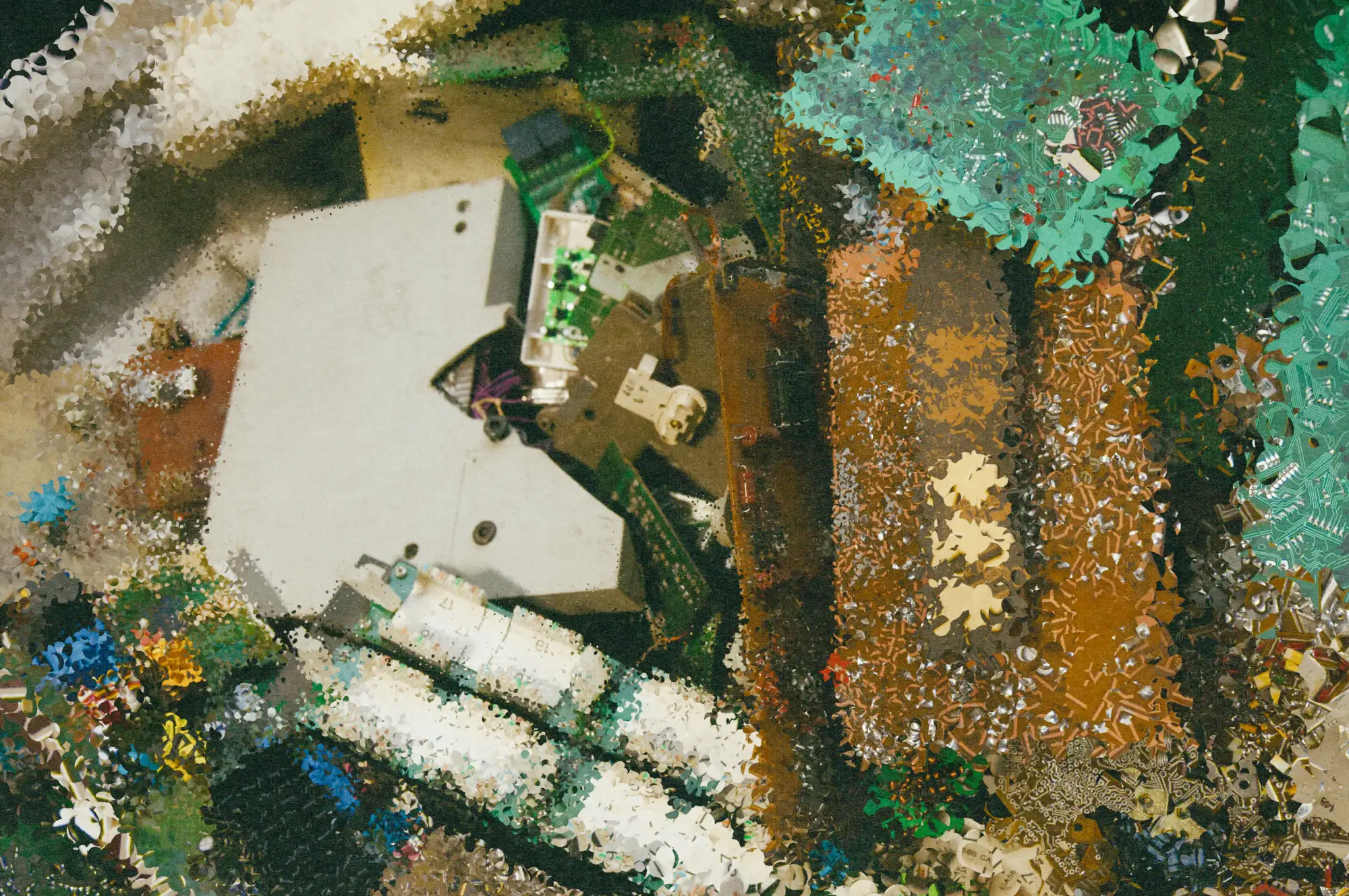
Keeping and repairing. The longest-lasting device is the one we already have. Since 31 July 2026, new EU rules on the right to repair have applied across its countries, and Croatia has written them into its consumer protection law (7). This new directive mandates the repair of certain products even after the statutory warranty has expired, ensuring the availability of spare parts. It prohibits the refusal of repair on the grounds that the product was previously repaired by an unauthorized service provider or even by the consumer themselves.
For products like smartphones, washing machines and fridges, people can now ask the manufacturer for a repair even after the legal guarantee has run out, and manufacturers must offer it at a reasonable price and within a reasonable time (7). Sellers must also tell customers that choosing a repair instead of a replacement extends the guarantee. Repair is slowly – or better said, again – becoming the expected first step, not the exception.
Repair is also becoming social again. In Zagreb, Fab City Zagreb hosts Repair Cafés where neighbours gather to fix household items together and learn basic repair skills (8), and Zelena Istra runs workshops on repair, upcycling, swapping and reuse. A broken object can become a reason to meet, to join, to repair more than the object itself.
Collecting. When a device truly reaches the end of its life, the most important thing is that it does not slip into the mixed bin. According to the Environmental Protection and Energy Efficiency Fund, Croatia collected and recycled 81.3% of its electrical and electronic waste in 2020, the highest share in the EU, well ahead of Sweden at 47% and Germany at 38.7% (1). That number is not only a system, it is individuals carrying old kettles to the reciklažno dvorište, and shops taking back old devices. This is something to be proud of.
Recycling with care. Collection is the first step, and careful sorting is the second. Separating plastics that contain flame retardants from those that do not is what keeps a recycled casing from carrying old chemicals into a new toy or kitchen tool. This part of the stream lies mostly with recyclers, manufacturers and regulators, and it is where collective pressure and a mindset shift, from all of us, matters most. For a start, we can take care to separate what we visibly can by ourselves.
Watching and learning. Further downstream, researchers at the Ruđer Bošković Institute are studying how microplastics, noise, pollution and climate change combine to affect the sea along the western coast of Istria, as part of the international MIRAMAR project running until the end of 2027 (10). They have even enlisted the sea’s own filters: Mediterranean mussels, which strain the water as they feed, placed along the coast to help measure microplastics over time.
Our next hue: walking upstream
If we are part of the circle of consumption, we are also part of where it is still forming. Here is where that cycle stops for a moment, and takes place.
Responsibility doesn’t have to feel impossible. It can feel like answering, question by question.
Within reach
- Open your drawer. Sort what could still be used, what could be repaired, and what is ready to go. Give working devices a second life with a friend, a school or a second-hand shop.
- Before replacing something broken, ask about repair first. Since July 2026, you can ask the manufacturer to repair phones, washing machines, fridges and other covered products even after the guarantee has ended, and choosing repair within the guarantee extends it.
- Never put electronics, cables or batteries in the mixed bin. Take them to a reciklažno dvorište or an electronics collection point.
- When you do buy something new, ask how long it is built to last, and whether spare parts are available.
With our neighbours
- Bring something broken to a Repair Café, or offer an hour of your own skills. Fixing things together is one of the oldest forms of community.
- Set up a small collection box for old chargers, cables and phones at your workplace, school or building, and take it to a collection point together.
- As well as sharing what you don’t use anymore, share what you learn. A neighbour who knows where the nearest reciklažno dvorište is will tell another.
Together, with Gradient Shift.
We cannot imagine – yet or anymore – a land without plastic. Can we imagine a sea without it? Perhaps not, not for what is already there, slowly growing smaller in the dark. But we can imagine a sea where less arrives each year. A gradient that has already begun to turn like the tide, and only grows stronger – if the particles that join are alive. Each of these acts is small. But like the particles we have followed downstream, they gather, they compound. Enough of us, and the stream turns.
Even though it is impossible, imagine. Imagine this story played backwards. The particles in the Adriatic drift together, finding one another in the dark. Fragments rejoin fragments. Edges smooth over. The algae lets go. A small grey body rises toward the surface, its cable uncurling behind it, and floats back up the river, back through the landfill, back into the bin, back into the drawer.
We cannot rewind the sea. We cannot call the pieces home. What is already there will stay for a long time, slowly growing smaller. But the story has many beginnings still unwritten. Somewhere in a drawer, or even back on the assembly line somewhere far in the world, there is an object that has not yet started its journey. It could still be repaired, still be made differently, still redirected. The sea doesn’t have to know about it now.
The sea cannot be played backwards, but the drawer can still be opened.
We may never see the sea
as it was before us.
Each wind brings
a colour of its own.
But we can choose
how we speak to it next,
we can still turn the tide.
Less of what we consumed,
more of what we answered for,
less answers to what
Earth didn’t ask for –
and we simply invented
from materials it has
never known.
Upstream,
the water is still listening,
it hasn’t yet
decided
where to go.
Sources
- N1 (2022): Croatia at top in EU in terms of recycling of electrical and electronic waste
- Dnevnik.hr (2026): Znanstvenik o alarmantnom otkriću o Jadranu: “Svi uzorci koje sam obradio su to imali i broj raste…”
- India Environment Portal / Guardian (2017): Fish mistaking plastic debris for food
- AdriCleanFish (2021): Ecological impacts of marine litter in the Adriatic
- News Tribune (2025): The real microplastics problem
- South Seattle Emerald (2024): How much plastic do we ingest?
- Informator (2026): Consumer protection law changes, including the right to repair
- Government of Croatia (2026): Proposal on the transposition of the repair directive
- Fab City Zagreb (2026): Repair Café in Sesvete
- Zelena akcija: Monthly workshops at the reuse centre
- Index.hr (2026): MIRAMAR project on pressures in the Adriatic