Imagine walking into a forest where nothing rustles. No buzzing in the undergrowth, no wingbeat overhead, no small sudden movement that makes you stop and look. For a moment it might even feel peaceful, a forest with nothing in it to startle us. A shadow in the water off the coast that might be a seal, or might be nothing. A meadow in June with no flowers on it. Only grass, in a single shade of green, as if painted.
We rarely picture these places, because wildlife feels like it lives somewhere else, at the edge of our maps and attention – in what seems as another wilder world. But these places and their wildlife inhabitants are never as far from us as it seems, they are simply unfamiliar. Imagining these possible worlds is getting to know what we are still able to keep – if we reach through the distances that keep us separated from wildlife.
The bee seems too small to notice, the monk seal too rare to meet, the bears and wolves too wild to welcome. What if we thought about our relations to these species differently – and each distance turned out to be an illusion, because we are entangled with all of them? Entanglement, to both our luck and responsibility, works both ways. As their lives, or their extinctions, affect ours, so we can affect theirs in return.
But first, we need to get to know them, to come closer – with wildlife, and with our fellow humans.
The wide view makes them too small to notice
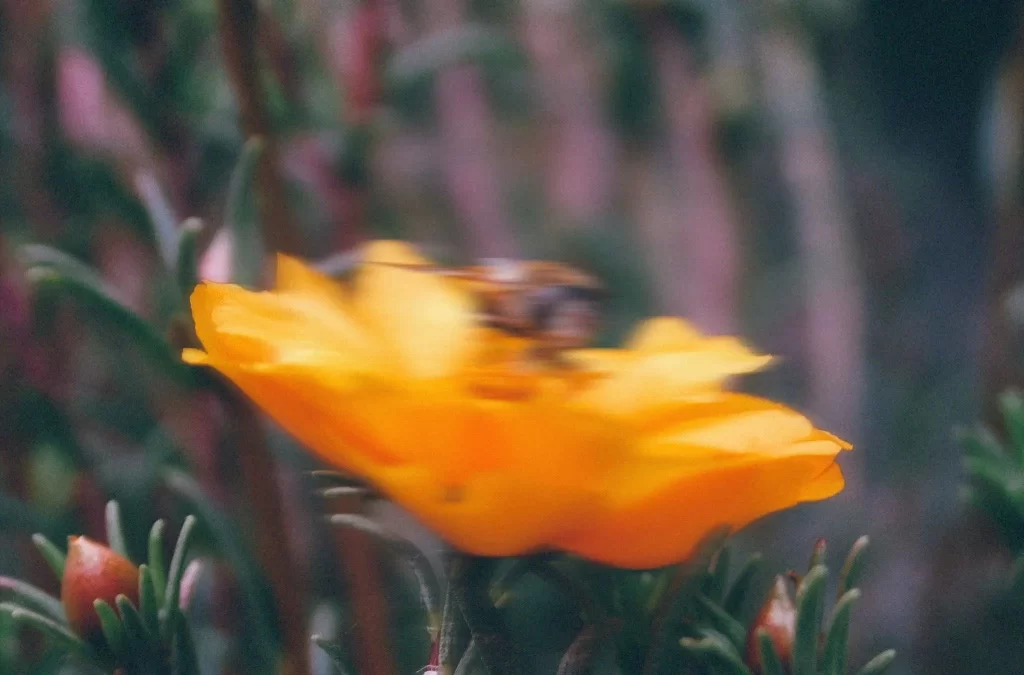
The first distance is scale. A wild bee or a hoverfly is so small that we barely register it, yet it sits at the centre of our everyday lives. In Europe, around four in five crop and wild-flowering plant species depend, at least in part, on animals to pollinate them (1). Think of the apple on the kitchen table, the cherries at the market in June, the lavender field on the island hillside, the clover that feeds the cows that give the milk.
These lives are thinning out. According to the European Red List, around one in three bee, butterfly and hoverfly species is declining, and one in ten bee and butterfly species is threatened with extinction (2).
When one species fades, the change rarely arrives all at once. It moves like a gradient: a plant that sets a little less seed, a flower that becomes a little rarer, a bird that finds a little less to eat. Each step is small. Together, they shift the colour of a whole landscape.
This is what we mean by entanglement. Wildlife isn’t only something we protect for its own sake. It is part of the fabric that holds up our food, our landscapes and our seasons.
But something as small as a bee is also hard to hold onto, to grasp our relationship towards it – and it seems that we can only approach it as a swarm ourselves. The EU has committed to reversing the decline of wild pollinators by 2030, and every member state, Croatia included, is due to start a standardised pollinator monitoring scheme by 16 December 2026 (1).
However, policy indeed flies at another scale than a bee – so this idea of smallness is something to keep close while finding our place in the wildlife crisis. Thinking of the great impact – or, appropriately, the butterfly effect – of a single bee, in relation to its community and habitat, we understand that individual action matters alongside the organizational.
This notion is why at the end of the article we want to note some small, gradient shifts that you can integrate into your life to strengthen this connection and presence with wildlife. The label of wildness and otherness is what makes us think we can not reach or affect the lives of these species – while they might actually be closer than we think.
A flutter of many wings does create wind,
and if we listen close, we can feel it on our skin.
We thought this collective air could only be felt
while standing quiet and still –
but it’s time to move, to buzz, to learn.
So we join them and move.
Move and move
in different swarms.
Dancing once again
with the wildlife
and the wild life
around us.
Closer to home, but too rare to meet
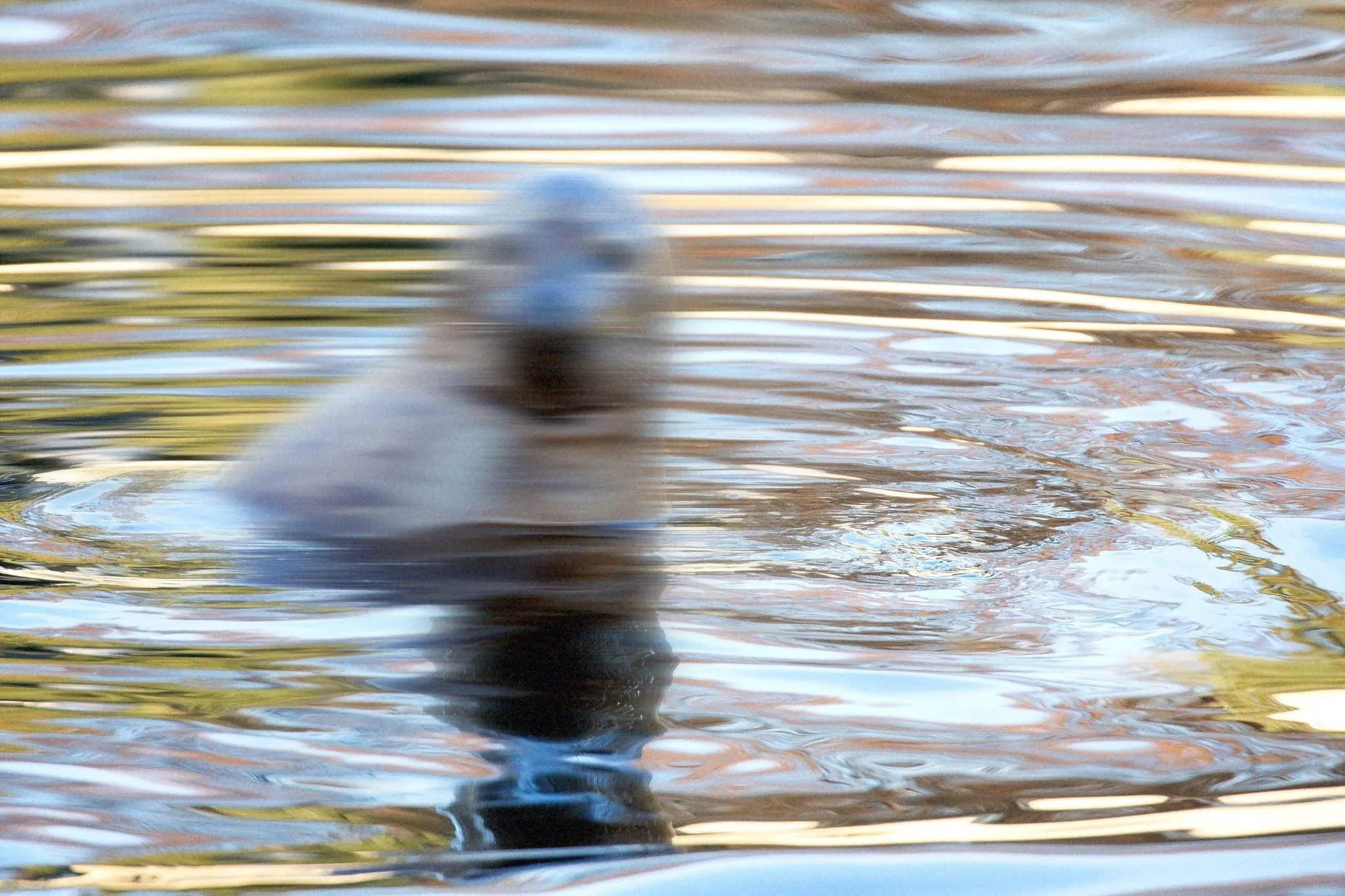
The second distance is rarity. Most of us in Croatia learn the name of the Mediterranean monk seal, sredozemna medvjedica, in primary school. Along the coast, some even know her as morski čovik – the sea human. This might be the first sign they are closer to us than we think. This animal is familiar as a word and almost a stranger as an animal.
Have you ever seen one? Would it change anything to know that you might never?
She is one of the rarest marine mammals on Earth. The most recent global estimate counts 815 to 997 individuals, of which only 443 to 599 are mature adults (3). And she belongs in our sea in a quite literal way: the species was first scientifically described in 1777, from an animal caught near the island of Cres. Through the 19th century she lived along the whole Adriatic coast, and Croatia first protected her in 1935 (4).
Today, Croatia has no confirmed permanent breeding population. Since the early 2000s, though, she has kept returning: photographed near Silba in 2005, seen later off Istria, in Kvarner and near Pašman, and most recently near Bibinje this summer (4).
Why did she become so rare? Not because she lives far from us, but because she lived so close. She was hunted, persecuted by fishers, tangled in nets, and pushed out by disturbance, tourism development, pollution and dwindling food (4). Monk seals once rested and bred on open beaches. After centuries of disturbance, females now tend to birth their young in remote sea caves, out of our sight.
Thinking of such an elusive species, it is interesting to think about entanglement in a different light. For the story of the seal, to be tangled might perhaps only suggest a fishing net. But for us, it is a way of understanding the whole story. We share a habitat with this animal even if we never share an encounter. Even if we don’t see the seal’s traces, because it has learned so carefully to hide them from humans, they touch all that makes up our seas. The beaches we choose, the boats we take into hidden coves, the fish on our plates, the plastic that drifts out to sea: all of this reaches her, in one form or another.
How do we care for a species we might never see?
By knowing that out of sight
is not out of reach.
Our sea is one,
in which we swim together –
held by the web of entanglement.
We weave each other’s survival,
each other’s generations,
just by noticing we coexist,
tangled together in
responsibility
and trust.
Where light comes through: too wild to welcome?
The third distance is fear. Fear to recognize, to encounter – both the danger that some wildlife represents for humans, but also: the danger that humans represent to wildlife.
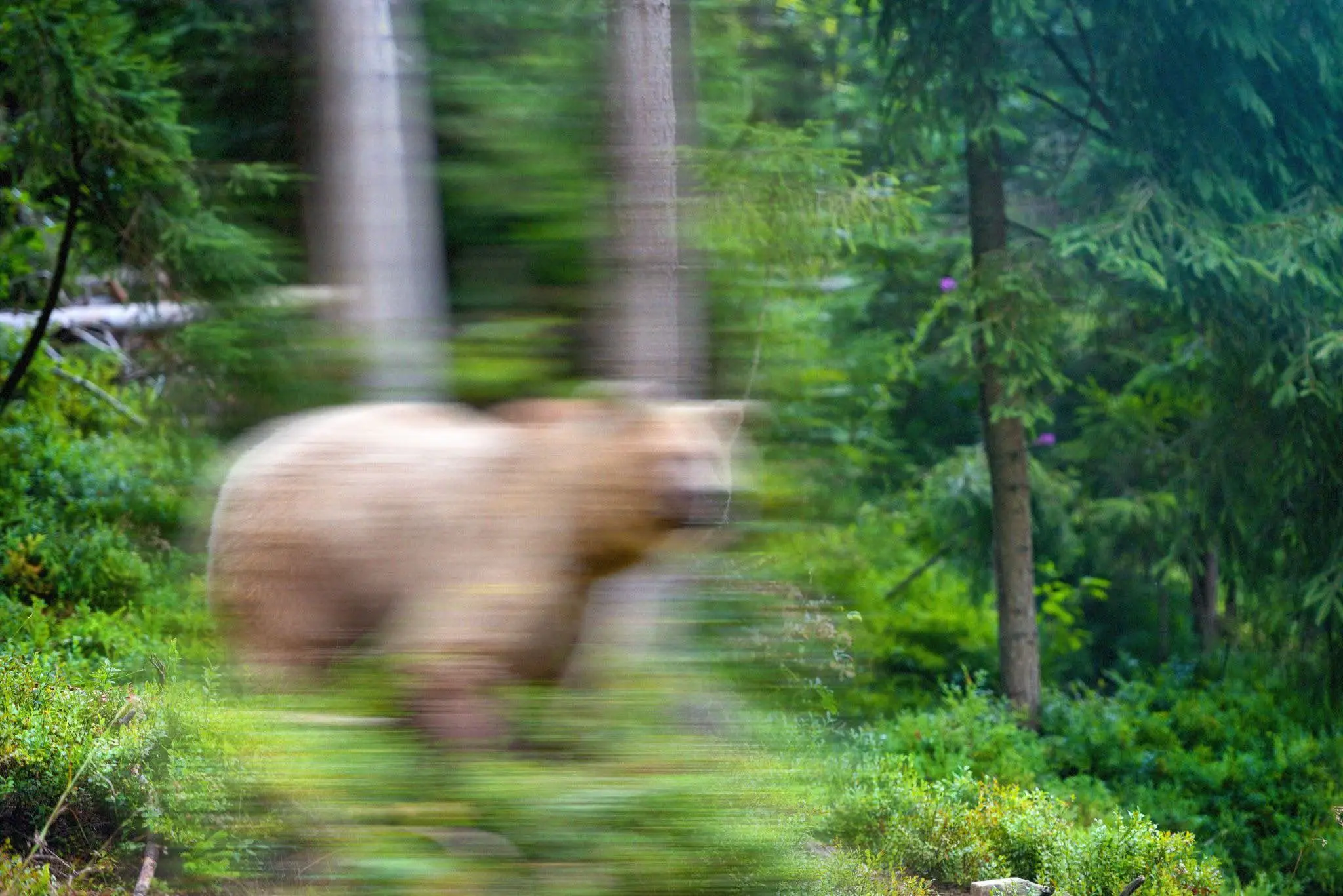
For many of us, the bear and the wolf are the very image of the wild: something to keep at arm’s length, perhaps within the pages of a fairy tale. And yet Croatia is one of the places in Europe where large carnivores still share the land with people. The brown bear lives across Gorski kotar, Lika and Velebit, and in recent years has settled further into Žumberak, Dinara, Mosor and Biokovo (7).
This is where the entanglement turns hopeful. The same closeness that once pushed species to the edge is also what lets us bring them back.
Counting bears in a forest that stretches across borders is close to impossible for scientists alone. So in 2015, researchers in Croatia and Slovenia asked the people who already walk those forests every day, hunters and foresters, to help. They held 48 meetings with hunting clubs in Croatia alone and handed out simple sampling kits. In four months, 962 volunteers collected 4,687 samples of bear droppings for DNA analysis, 56% more than planned. The result was Croatia’s first reliable estimate of its brown bear population (6). That count found around 937 bears. Croatia’s most recent report to the EU, submitted in 2025, rated the bear population as favourable and stable in all three of the country’s biogeographical regions (7).
In almost every conservation plan, one objective appears again and again: public awareness and education. This is where we hope to come in, to close distances that block us from acting positively for our environment and those who we share it with.
This idea is on the list of priorities for the monk seal, and it runs through Croatia’s plans for bears and wolves. Knowing is the first tool of conservation. Every person who knows what a monk seal needs, or why a bin lid matters in Lika, becomes part of the habitat’s protection.
Our next hue: how we can help
If we are entangled with the wild, then we are also able to tend it.
Here is how that can look, from your own windowsill outward.
Change doesn’t have to feel like anything wild… at first.
Within reach
- Leave a corner of your garden, balcony box or courtyard to grow a little wild. Native flowering plants and a patch of unmown grass are a feast for wild bees and hoverflies.
- At the coast, give sea caves and quiet coves their silence. If you meet a monk seal, keep your distance, keep dogs on a lead, and never approach or touch her. A photo or video from afar helps scientists identify individuals (BIOM / Adriatic Monk Seal Project). Then report the sighting: note the exact place, date and time, how many animals, and what they were doing, and pass it on to the Adriatic Monk Seal Project partners, a conservation group or the authorities.
With our neighbours
- In bear country, a closed bin is an act of care. Ask your municipality or holiday host how waste is stored and support bear-proof containers where they are missing.
- Join a citizen-science count. From bears in the Dinarides to butterflies in your park, monitoring depends on ordinary people who notice. The EU’s new pollinator monitoring scheme will need more eyes too. A bee might have five eyes, but as two-eyed humans we need to work together to see what is at stake.
- Support marine protected areas and the local groups who look after them, through your time, your voice at public consultations, or your choices as a visitor.
Together, with Gradient Shift.
Every one of these actions might be small, and seem far as you are reading this – but keep them on your mind as you move through habitats. Together, they can shift the colour of a landscape back to the livelier side of the gradient.
Now, go back to the forest from the beginning. This time, something rustles in the undergrowth. Maybe it is a blackbird, maybe a hedgehog, maybe, deep in Gorski kotar, something much larger that already knows to keep its distance.
The wild was never somewhere else. It is in our food, our shores and our forests. Out of sight, but never out of reach. How do we find out who else lives here with us – and how to live in reciprocity?
We may never meet them.
But they will know that we were here,
and how we chose to share it.
How we chose
to live together.
Sources
- European Commission: Pollinators
- European Commission: Revision of the EU Pollinators Initiative
- Karamanlidis (2024), Endangered Species Research: status and conservation priorities of the Mediterranean monk seal
- tportal (24 Aug 2026): monk seal sighting near Bibinje
- BIOM / Adriatic Monk Seal Project leaflet (2026)
- European Commission (2025): bear monitoring in Croatia and Slovenia
- Ministry of Agriculture, Forestry and Fisheries: Brown bear action plan 2026